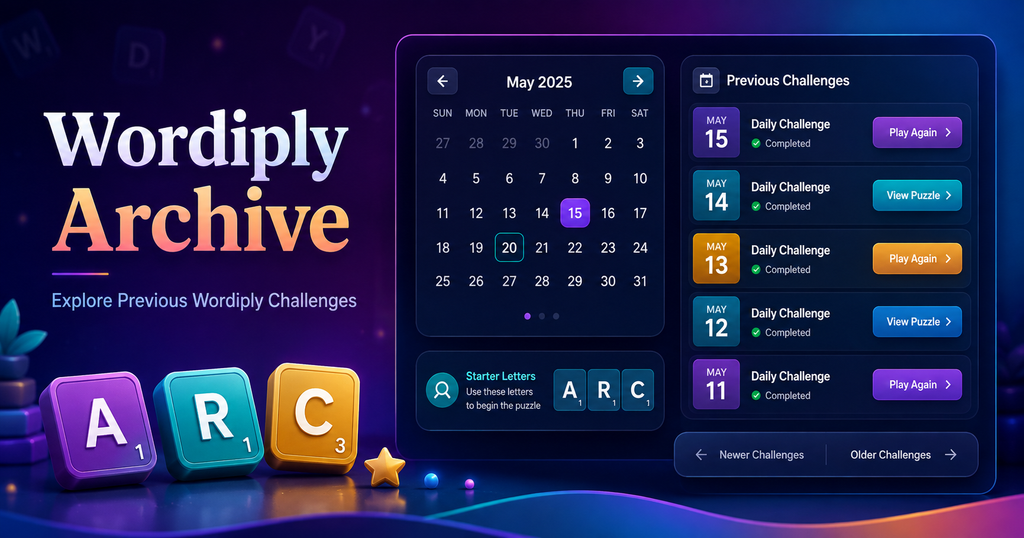
Wordiply Archive is a useful place for players who want to explore previous Wordiply challenges, revisit older starter sequences, and continue practicing their word-building skills beyond the latest daily puzzle.
Daily word games are enjoyable, but sometimes players want more than one challenge. A Wordiply Archive makes it easier to return to earlier puzzles, compare different starter sequences, and practice finding longer words at your own pace.
Whether you missed a previous challenge or simply want additional vocabulary practice, the Wordiply Archive can help you discover more word-building opportunities.
What Is the Wordiply Archive?
The Wordiply Archive is a collection of previous Wordiply-style challenges and word-building activities.
Instead of being limited to the current daily challenge, players can use an archive to revisit older starter sequences and try solving them again.
Each previous challenge can provide a new opportunity to:
- Find longer words
- Improve vocabulary
- Practice letter patterns
- Compare different answers
- Build better word-game strategies
The Wordiply Archive is especially useful for players who enjoy regular practice.
Why Use the Wordiply Archive?
There are several reasons why players may want to explore previous Wordiply challenges.
Play Missed Challenges
If you did not have time to complete a daily challenge, the archive can help you return to older puzzles.
This means you do not have to miss useful practice simply because you skipped a day.
Practice More Frequently
A daily challenge provides one puzzle, but some players want additional practice.
The Wordiply Archive can provide access to more starter sequences so you can continue playing whenever you want.
Improve Word Recognition
Different starter sequences appear inside different types of words.
By working through several older challenges, you can become better at recognizing useful letter combinations inside longer vocabulary.
Compare Your Progress
Older puzzles can also help you measure improvement.
A starter sequence that once felt difficult may become much easier after regular practice.
How to Use the Wordiply Archive
Using the Wordiply Archive should be simple.
Choose a Previous Challenge
Start by selecting an older challenge or date.
Each challenge should contain a starter sequence that you can use to begin your word search.
Find Words Containing the Starter
Look for words containing the required sequence in the correct order.
Start with a simple valid word and then try to find longer alternatives.
Compare Different Possibilities
Do not stop after finding one answer.
Explore:
- Longer words
- Different word forms
- Prefixes
- Suffixes
- Plural forms
- Less common vocabulary
This can make each archived challenge more useful for learning.
Wordiply Archive for Daily Practice
The Wordiply Archive can turn one daily word puzzle into a much larger practice resource.
Instead of waiting for the next day’s challenge, you can choose an older starter sequence and continue improving your vocabulary.
A simple practice routine could be:
Choose one old challenge.
Find at least three valid words.
Try to improve each answer.
Search for the longest word you can think of.
Review any unfamiliar vocabulary.
This approach can make Wordiply practice more structured and enjoyable.
How Archived Wordiply Challenges Improve Vocabulary
One of the biggest benefits of revisiting previous puzzles is exposure to different letter combinations.
Some starter sequences appear in many everyday words.
Others may appear mainly in longer or less familiar vocabulary.
Working with a variety of sequences can help players notice:
- Common prefixes
- Common suffixes
- Word roots
- Spelling patterns
- Longer word forms
- Vocabulary relationships
The more patterns you recognize, the easier future Wordiply challenges may become.
Tips for Playing Old Wordiply Challenges
Older challenges should still be treated like fresh puzzles.
Try Without Help First
Before using any hints or a solver, spend some time thinking independently.
This gives you the best vocabulary practice.
Look for Longer Alternatives
Once you have found one valid word, challenge yourself to improve it.
The first answer is often not the longest possible option.
Use Prefixes and Suffixes
Adding or recognizing prefixes and suffixes can lead to much longer words.
Useful examples include:
re-
un-
pre-
inter-
-ing
-tion
-ment
-able
-ation
Learn From Difficult Challenges
If a starter sequence feels unusually hard, do not skip it immediately.
Difficult sequences can be useful because they force you to think beyond familiar vocabulary.
Wordiply Archive and Wordiply Solver
The Wordiply Archive and Wordiply Solver can work well together.
The archive provides previous starter sequences for practice.
The solver can help when you become stuck and want to explore possible words containing a particular sequence.
A good approach is to attempt the archived challenge independently first.
Then use the Wordiply Solver afterward to compare your answers and discover longer possibilities.
This makes the solver a learning tool rather than simply a shortcut.
Wordiply Archive and Wordiply Answers
Wordiply Answers can also be useful when revisiting older challenges.
After completing a puzzle, you may want to compare your words with other possibilities.
Reviewing possible answers can help you discover:
- Longer words
- Unfamiliar vocabulary
- Alternative word forms
- Useful spelling patterns
The combination of the Wordiply Archive, Solver, and Answers pages can create a useful practice system for word-game players.
Who Can Benefit From the Wordiply Archive?
The Wordiply Archive can be useful for many types of players.
Regular Word Game Players
People who enjoy daily vocabulary puzzles can use the archive for additional challenges.
Beginners
New players can practice older challenges before focusing on daily results.
Students
Word-building activities can encourage vocabulary awareness and spelling practice.
English Learners
Exploring different word forms can help learners become more familiar with English vocabulary and structure.
Competitive Players
Players who enjoy improving their personal performance can use archived challenges to practice finding longer answers.
Common Mistakes When Playing Archived Challenges
Looking at Answers Too Early
Checking possible answers immediately removes much of the challenge.
Try solving the puzzle yourself first.
Using Only Short Words
Short answers may be valid, but the goal of practice should be to explore longer possibilities.
Ignoring New Vocabulary
If you discover an unfamiliar word, learn what it means.
This makes each archived challenge more useful.
Rushing Through Multiple Puzzles
Quality practice is more valuable than completing many challenges quickly.
Spend time examining each starter sequence carefully.
Can You Replay Wordiply Challenges?
An archive-style resource can allow players to revisit previous Wordiply-style challenges for additional practice.
Replaying older sequences can be especially helpful because you may discover stronger answers the second time.
A word that seemed difficult to find previously may become obvious after your vocabulary improves.
Frequently Asked Questions About Wordiply Archive
What Is the Wordiply Archive?
The Wordiply Archive is a resource for exploring previous Wordiply-style challenges and starter sequences.
Why Should I Play Old Wordiply Challenges?
Previous challenges provide additional vocabulary practice and allow you to improve your word-building skills without waiting for a new daily puzzle.
Can I Use the Wordiply Solver With Archive Challenges?
Yes. You can use the Wordiply Solver to explore possible words after trying an archived challenge independently.
Can the Wordiply Archive Help Improve Vocabulary?
Yes. Working with different starter sequences can introduce you to new words and improve your recognition of prefixes, suffixes, and spelling patterns.
Is Wordiply.net the Official Guardian Website?
No. Wordiply.net is an independent word-game resource and is not affiliated with, endorsed by, or operated by The Guardian.
Final Thoughts on Wordiply Archive
Wordiply Archive can be a valuable resource for players who want more practice than a single daily challenge provides. Revisiting previous starter sequences gives you more opportunities to find longer words, improve vocabulary, and become better at recognizing useful letter patterns.
Instead of treating older challenges as finished puzzles, use them as practice material. Try each starter independently, improve your first answer, compare different possibilities, and learn from unfamiliar words.
With regular practice, the Wordiply Archive can help make future Wordiply challenges easier, more interesting, and more rewarding.
Read more: Wordiply